


Page 40 - Demo
P. 40
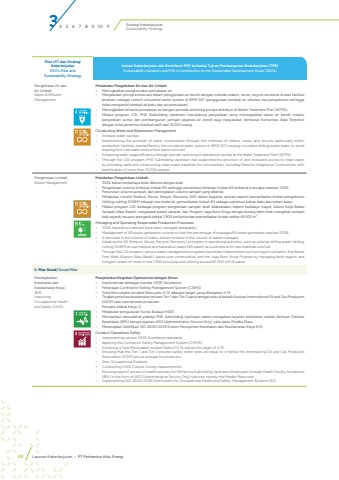
Strategi KeberlanjutanSustainability StrategyPilar LST dan Strategi KeberlanjutanESG's Pillar andSustainability StrategyInisiasi Keberlanjutan dan Kontribusi PHE terhadap Tujuan Pembangunan Berkelanjutan (TPB)Sustainability Initiation and PHE's Contribution to the Sustainable Development Goals (SDGs)Pengelolaan Air dan Air LimbahWater & Effluent ManagementMelakukan Pengelolaan Air dan Air Limbah%u2022 Meningkatkan penghematan pemakaian air.%u2022 Menjalankan prinsip konservasi dalam penggunaan air bersih dengan metode reduce, reuse, recycle terutama di area fasilitas produksi sebagai contoh circulated water system di BMR 001 (penggunaan kembali air sirkulasi sisa pengeboran sehingga tidak mengambil kembali air baku dan air permukaan).%u2022 Meningkatkan efisiensi pemakaian air dengan periodik switching pompa distribusi di Water Treatment Plan (WTPA). %u2022 Melalui program CID, PHE Subholding Upstream mendukung penyediaan serta meningkatkan akses air bersih melalui penyediaan sumur dan pembangunan jaringan pipanasi air bersih bagi masyarakat, termasuk Komunitas Adat Terpencil dengan total penerima manfaat lebih dari 10.000 orang.Conducting Water and Wastewater Management%u2022 Increase water savings.%u2022 Implementing the principle of water conservation through the methods of reduce, reuse, and recycle, particularly within production facilities, exemplified by the circulated water system in BMR 001 (reusing circulated drilling waste water to avoid drawing from raw water and surface water sources). %u2022 Enhancing water usage efficiency through periodic switching of distribution pumps at the Water Treatment Plant (WTPA).%u2022 Through the CID program, PHE Subholding Upstream has supported the provision of and increased access to clean water by providing wells and constructing clean water pipelines for communities, including Remote Indigenous Communities with beneficiaries of more than 10,000 people.Pengelolaan LimbahWaste ManagementMelakukan Pengelolaan Limbah%u2022 100% bahan berbahaya telah dikelola dengan baik.%u2022 Pengelolaan volume timbulan limbah B3 sehingga persentase timbulan limbah B3 terkelola mencapai sebesar 100%.%u2022 Penurunan volume sampah, dan peningkatan volume sampah yang dikelola.%u2022 Melakukan inisiatif Reduce, Reuse, Recyle, Recovery (4R) dalam kegiatan operasi seperti pemanfaatan limbah pengeboran(drilling cutting SOBM) sebagai raw material, pemanfaatan limbah B3 sebagai substitusi bahan baku dan bahan bakar.%u2022 Melalui program CID, berbagai program pengelolaan sampah telah dilaksanakan seperti budidaya magot, Aliansi Kerja Bebas Sampah (Akar Basah), masyarakat peduli sampah, dan Program Jaga Bumi Kroya dengan kurang lebih telah mengelola sampah baik organik maupun anorganik sekitar 1.900 ton/tahun dan pemanfaatan limbah sekitar 65.000 m3.Managing and Operating Responsible Production Processes%u2022 100% hazardous materials have been managed adequately.%u2022 Management of B3 waste generation volume so that the percentage of managed B3 waste generation reaches 100%. %u2022 A decrease in the volume of waste, and an increase in the volume of waste managed.%u2022 Initiating the 4R (Reduce, Reuse, Recycle, Recovery) principles in operational activities, such as utilizing drilling waste (drilling cutting SOBM) as raw material and hazardous waste (B3 waste) as a substitute for raw materials and fuel.%u2022 Through the CID program, various waste management programs have been implemented such as magot cultivation, the Waste Free Work Alliance (Akar Basah), waste care communities, and the Jaga Bumi Kroya Program by managing both organic and inorganic waste of more or less 1,900 tons/year and utilizing around 65,000 m3 of waste.II. Pilar Sosial/ Social PillarMeningkatkan Kesehatan danKeselamatan Kerja (K3)Improving Occupational Health and Safety (OHS)Menjalankan Kegiatan Operasional dengan Aman%u2022 Implementasi berbagai standar HSSE Excellence.%u2022 Penerapan Contractor Safety Management System (CSMS).%u2022 Total Recordable Incident Rate yaitu 0,14 dibawah target yang ditetapkan 0,19. %u2022 Tingkat peristiwa keselamatan proses Tier 1 dan Tier 2 sama dengan atau di bawah Asosiasi International Oil and Gas Producers (IOGP) rata-rata tahunan produsen.%u2022 Penyakit Akibat Kerja: 0.%u2022 Melakukan pengukuran Survei Budaya HSSE.%u2022 Memastikan kemudahan pekerja PHE Subholding Upstream dalam mengakses layanan kesehatan melalui Bantuan Fasilitas Kesehatan (BFK) berupa layanan ASO (Administrative Service Only) yaitu kartu Medika Plaza.%u2022 Menerapkan Sertifikasi ISO 45001:2018 Sistem Manajemen Kesehatan dan Keselamatan Kerja (K3). Conduct Operations Safely%u2022 Implementing various HSSE Excellence standards.%u2022 Applying the Contractor Safety Management System (CSMS).%u2022 Achieving a Total Recordable Incident Rate of 0.14, below the target of 0.19.%u2022 Ensuring that the Tier 1 and Tier 2 process safety event rates are equal to or below the International Oil and Gas Producers Association (IOGP) annual average for producers.%u2022 Zero Occupational Diseases.%u2022 Conducting HSSE Culture Survey measurements.%u2022 Ensuring ease of access to health services for Pertamina Subholding Upstream employees through Health Facility Assistance (BFK) in the form of ASO (Administrative Service Only) services, namely the Medika Plaza card.%u2022 Implementing ISO 45001:2018 Certification for Occupational Health and Safety Management Systems (K3). 3 4 5 6 7 8 9 10 1138 Laporan Keberlanjutan %u2022 PT Pertamina Hulu Energi


